
Essbase on Oracle Autonomous AI Lakehouse: A New Home for Managed Analytics
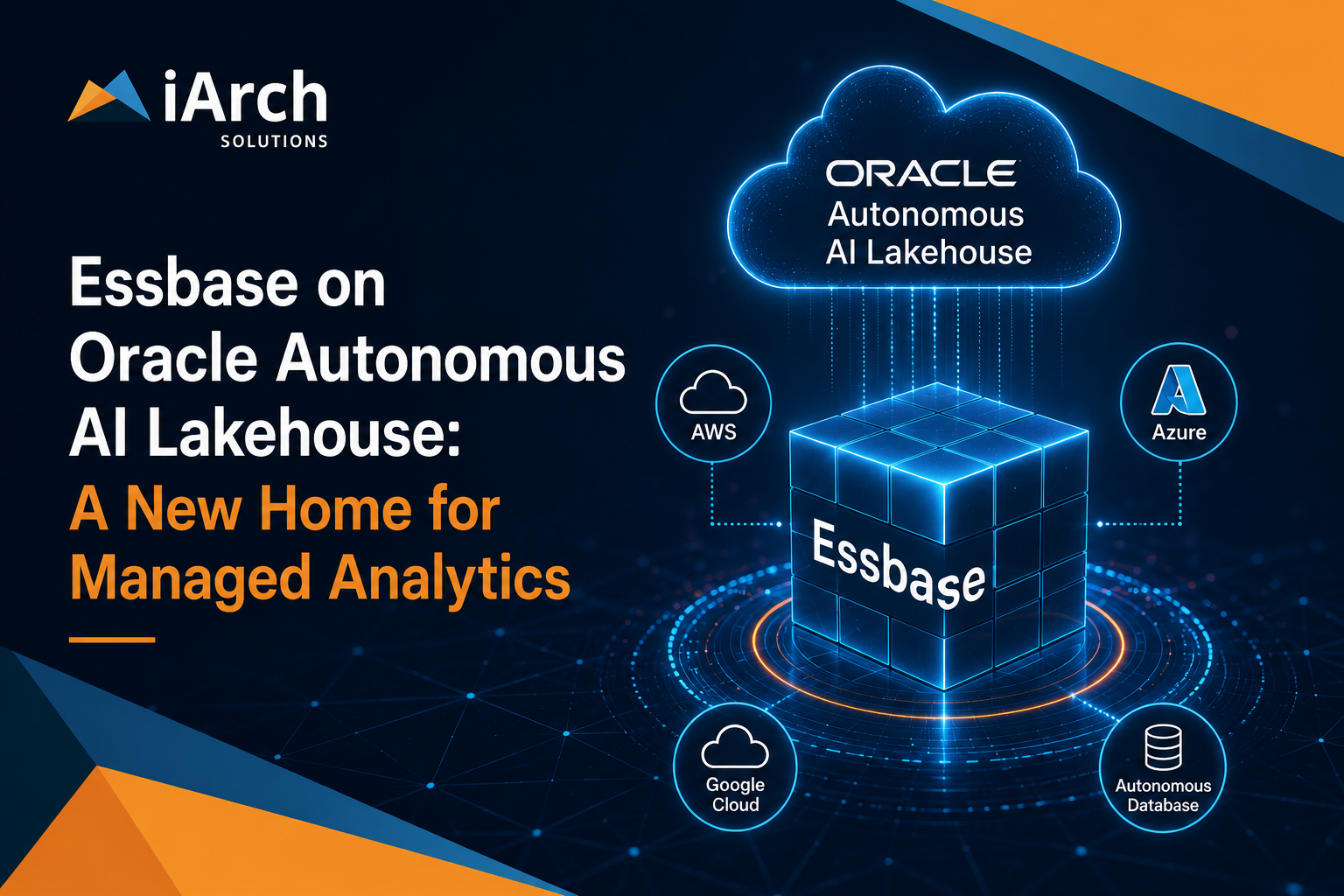
Oracle has introduced a fundamentally new deployment model for Essbase — one that moves away from infrastructure management entirely and places the analytics engine directly on top of Oracle's Autonomous Database and AI Lakehouse platform. This isn't simply Essbase in the cloud; it's a rethinking of where Essbase lives, how it's operated, and what it can connect to.
What Is Essbase on Autonomous AI Lakehouse?
Essbase on Autonomous AI Lakehouse is a fully Oracle-managed Essbase experience, launched directly from Oracle Data Studio and backed by Autonomous Database. Rather than provisioning a virtual machine, configuring WebLogic, managing storage volumes, and handling patching cycles, users provision an Essbase instance through the Data Studio interface and Oracle handles the infrastructure layer entirely.
The metadata and cube data run on Autonomous Database and AI Lakehouse services. From the user's perspective, the familiar Essbase toolset remains intact — Smart View, MDX, calculation scripts, and REST APIs all continue to work exactly as they do today. What changes is everything underneath.
Why This Architecture Matters
The case for this model rests on five practical pillars:
Less to operate. VM sizing, OS patching, backup scheduling, DR configuration, and storage management all shift to Oracle. For teams that are currently spending significant administrator time keeping Essbase infrastructure healthy, this is a meaningful reduction in operational overhead.
Data gravity. One of the persistent friction points in traditional Essbase deployments is data movement — extracting data from source systems, loading it into cubes, and keeping everything synchronized. Essbase on AI Lakehouse is designed to run analytics where the data already lives, minimizing unnecessary movement and the latency and consistency issues that come with it.
Autonomous Database platform capabilities. By sitting on ADB, Essbase inherits enterprise-grade scale, security, high availability, and backup and restore capabilities that would otherwise require significant additional engineering to replicate in a self-managed deployment.
Richer modeling at the data layer. Running Essbase on ADB opens up write-back scenarios, what-if modeling, and financial intelligence capabilities directly against the database platform — adding Essbase's multidimensional modeling strengths to a governed relational data store rather than maintaining a separate analytical silo.
Familiar workflows preserved. Existing Essbase applications, tools, APIs, and user workflows carry forward. The migration path is designed not to require retraining users or rebuilding applications from scratch.
Multicloud and Open Lakehouse Design
One of the more forward-looking aspects of this architecture is its explicit design for open lakehouse and multicloud data patterns. The managed offering supports data sources from Oracle Cloud, AWS, Azure, and Google Cloud, and is built around open table formats including Apache Iceberg. This means organizations that have data distributed across cloud providers, or that are building open lakehouse architectures, can bring Essbase's multidimensional analytics to that data without centralizing it into a proprietary store first.
How It Compares to OCI Marketplace
The managed offering and the OCI Marketplace image serve different needs and different customer profiles:
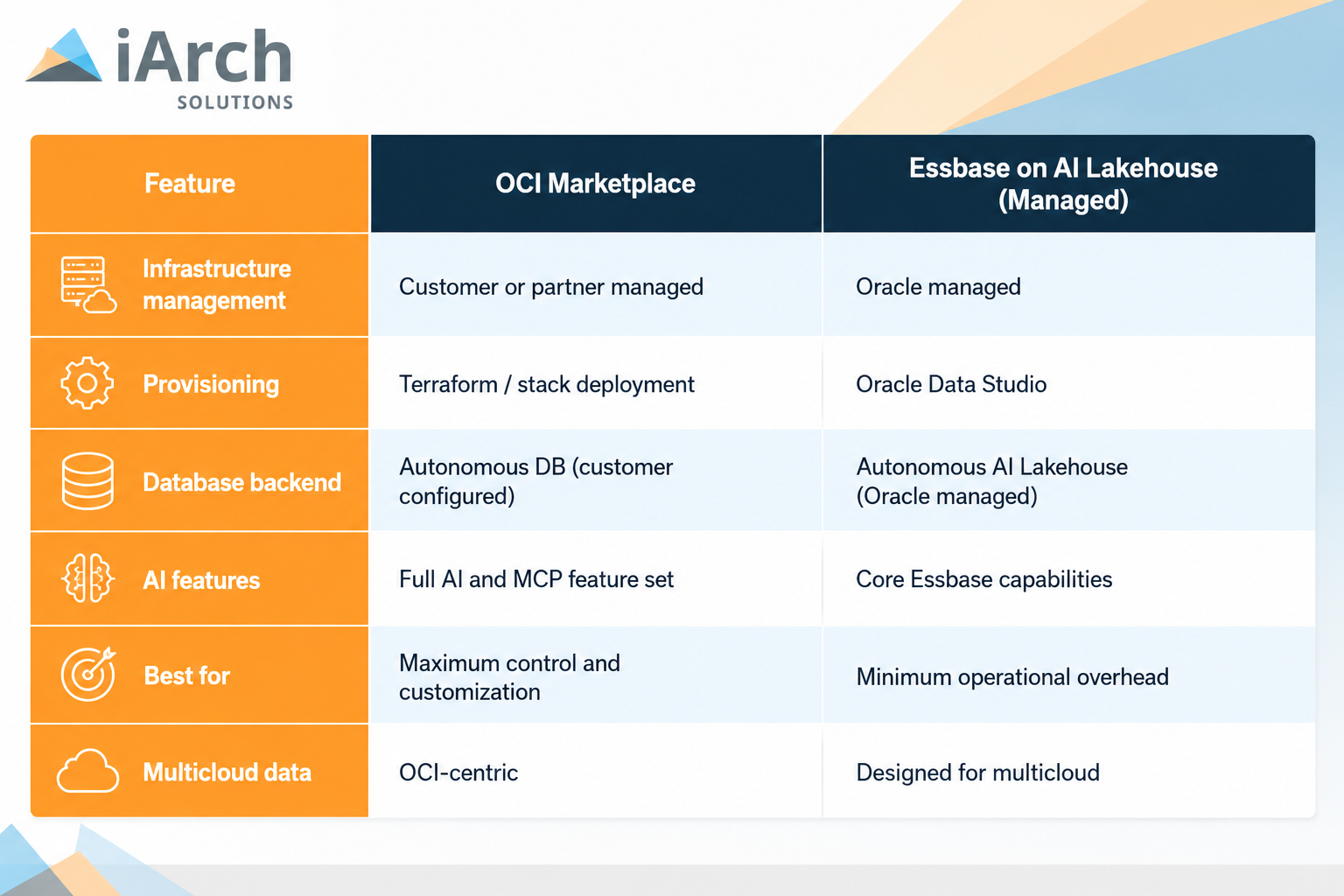
The Marketplace remains the right choice for organizations that need full control over their environment, want access to the complete AI and MCP feature set, or have specific infrastructure or network requirements. The managed offering is the better fit when the priority is reducing operational burden and running analytics close to where data already lives.
What This Means for Existing Essbase Customers
For customers currently running Essbase on-premises or on the OCI Marketplace, the managed offering represents an additional option rather than a replacement. Oracle has been clear that the on-premises and Marketplace paths continue to be actively developed — the 2026 release cycle demonstrates that commitment with the enhancements covered in the first blog in this series.
What the AI Lakehouse offering adds is a path for organizations that want to reduce infrastructure ownership progressively over time, or that are building new analytical workloads and want to start on a fully managed foundation rather than inheriting the operational complexity of a self-managed deployment.
Oracle's vision here is coherent: Essbase as a multidimensional analytics capability that can be deployed wherever makes sense for the organization — on-premises for maximum control, OCI Marketplace for cloud flexibility with full feature access, and Autonomous AI Lakehouse for teams that want to eliminate infrastructure management and bring analytics closer to their data. The trajectory is clearly toward deeper integration with Oracle's broader data platform, and the managed offering is the most direct expression of where that leads.
Ready to Find the Right Essbase Path?
You need an Essbase strategy that supports today’s operations without locking you into tomorrow’s complexity. Whether your team needs maximum control, a lower-management cloud path, or a fully managed AI Lakehouse foundation, iArch Solutions can help you evaluate the tradeoffs and move forward with confidence. Schedule a conversation with our Oracle analytics experts at and let’s identify the Essbase deployment model that fits your data strategy, operational goals, and long-term roadmap.
Source
Content derived from the presentation "Essbase Strategy & Roadmap" delivered at the Kscope 2026 Essbase Symposium by Ekrem
Soylemez, Vice President, Product Development, Oracle and Ashish Jain, Sr. Manager, Product Management, Oracle. June 2026.
Safe Harbor Statement
The preceding content is intended to outline Oracle's general product direction. It is intended for information purposes only, and may
not be incorporated into any contract. It is not a commitment to deliver any material, code, or functionality, and should not be relied upon in making purchasing decisions. The development, release, timing, and pricing of any features or functionality described for Oracle's products may change and remains at the sole discretion of Oracle Corporation.
Copyright © 2026, Oracle and/or its affiliates. All rights reserved.