OCI, multicloud, on-premises, or some combination. The options are multiplying. Getting to the right answer for your specific environment is harder than any vendor will admit.
A few years ago the Oracle Database decision was simpler. Now Oracle runs natively inside Azure, AWS, and Google Cloud. OCI has matured into a serious platform for Oracle workloads. Autonomous Database is eliminating whole categories of DBA overhead. And leadership is asking cloud strategy questions that did not exist two years ago.
Meanwhile your environment has complexity that does not show up in a migration checklist. The RAC configuration that took months to stabilize. The Data Guard setup that is the only thing standing between the business and a bad day. The licensing position that changes the math on every cloud option differently. Moving any of that without a clear framework for evaluating the options is how projects go sideways.
The risk of the wrong decision is not abstract. A poorly designed cloud deployment does not just cost money. It trades a stable environment you control for a cloud problem your team does not yet know how to fix. And the options keep getting more complex, not less.
Get a Clear Picture of Where OCI Fits Your Oracle Environment
Take the Cloud Fit Check. It is built for Oracle Database environments specifically. Answer a few questions about your workload and get an honest picture of where OCI and multicloud options add real value for your situation, and where they do not. No sales call required.
What the Oracle Cloud and Multicloud Landscape Actually Looks Like
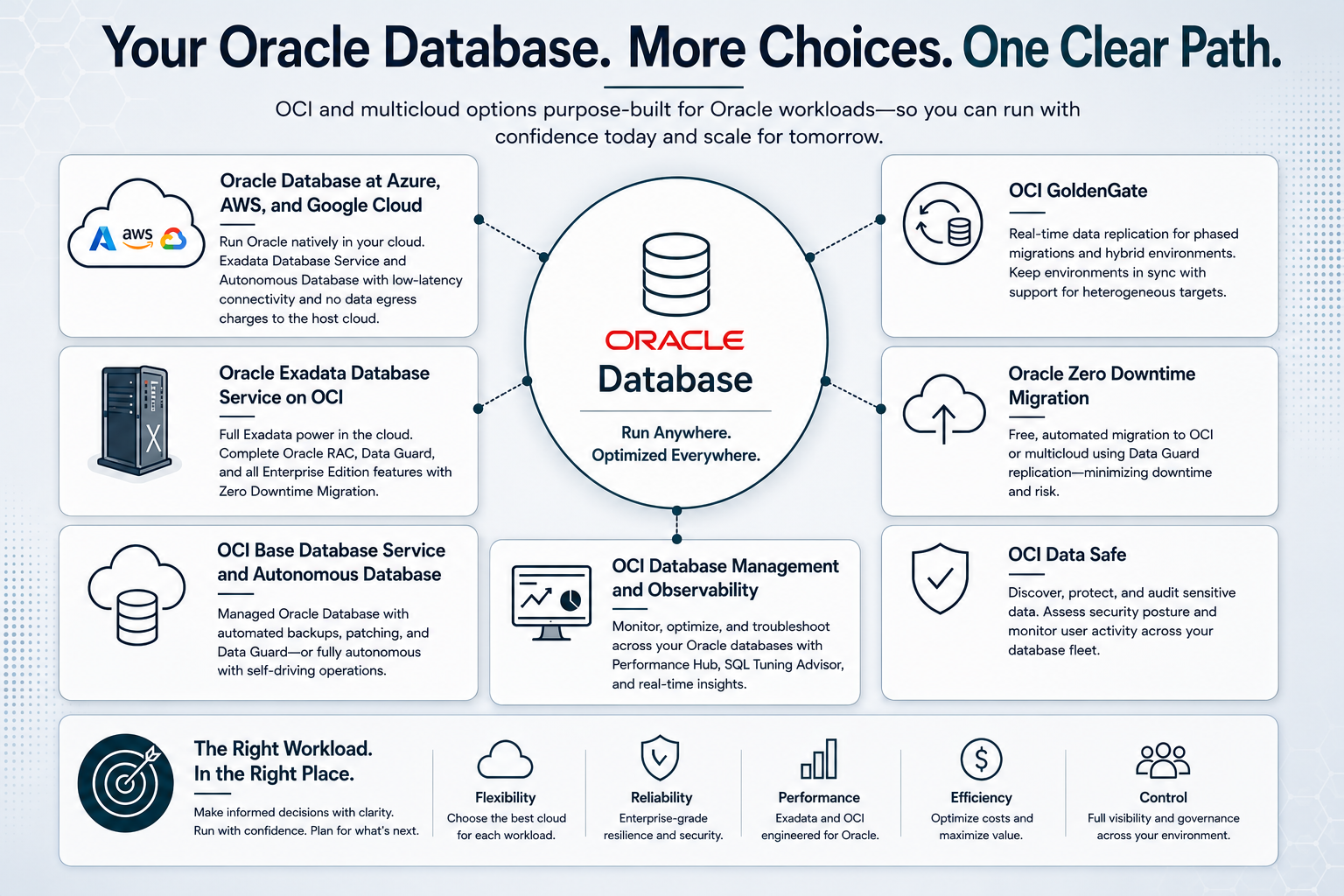
Oracle Database at Azure, AWS, and Google Cloud
Oracle now runs natively inside all three major clouds. Oracle Database at Azure, Oracle Database at AWS, and Oracle Database at Google Cloud each put Exadata Database Service and Autonomous Database directly inside the hyperscaler data center, with a low-latency interconnect to your cloud-native workloads and no data egress charges between Oracle and the host cloud. If your organization is already committed to one of these platforms, this changes the evaluation entirely. You no longer have to choose between Oracle performance and your existing cloud strategy.
Oracle Exadata Database Service on OCI
The same Exadata hardware and software stack you run on-premises, available in the cloud. Full Oracle RAC, Data Guard, and all Enterprise Edition features and options. Zero Downtime Migration automates the cutover using Data Guard replication so production impact is minimal. For environments where Exadata performance is non-negotiable and OCI is the right home, this is the path that does not require compromise.
OCI Base Database Service and Autonomous Database
For workloads that do not need full Exadata infrastructure, Base Database Service gives you managed Oracle Database on OCI with automated backups, patching, and Data Guard while you retain full DBA access and control. Autonomous Database goes further, handling tuning, scaling, and maintenance automatically. It is not right for every workload, particularly where custom configurations are required, but for appropriate workloads it eliminates significant routine overhead without sacrificing Oracle capabilities.
OCI GoldenGate
Real-time data replication between on-premises and OCI, or between Oracle and non-Oracle targets, for phased migrations and long-term hybrid environments. For organizations that need to move in stages rather than commit to a hard cutover, GoldenGate keeps both environments in sync throughout the process. It also supports heterogeneous replication for shops that need Oracle data flowing into cloud data warehouses or analytics platforms.
Oracle Zero Downtime Migration
A free, automated migration tool that uses Data Guard replication to move production Oracle databases to OCI or multicloud targets with minimal cutover windows. ZDM supports physical and logical migration methods, handles pre- and post-migration validation, and follows Oracle MAA best practices by default. For organizations where downtime risk is the primary barrier to cloud evaluation, ZDM removes most of that risk from the equation at no additional cost.
OCI Data Safe
Database security, sensitive data discovery, data masking, user activity auditing, and security assessment across your Oracle Database fleet on OCI. For DBAs managing environments with compliance requirements or audit pressure, Data Safe gives you a centralized view of security posture across multiple databases without building that capability from scratch. It surfaces risks you may not know exist and gives you the audit trail when someone asks for it.
OCI Database Management and Observability
Fleet-level monitoring, Performance Hub, SQL Tuning Advisor, and real-time database diagnostics across your OCI Oracle Database environments. For DBAs managing multiple databases, this is the operational visibility layer that replaces the patchwork of scripts and manual checks that tend to accumulate over time. Alerting, performance baselines, and blocking session analysis are available without standing up additional tooling.
When the right workloads are in the right place, the options stop feeling like a problem and start feeling like an advantage. Your environment is defensible. The multicloud question has a real answer. And the quarterly conversation with leadership about cloud strategy becomes one you can lead rather than survive.
Your systems become reliable enough that you can stop managing the conversation about cloud and start running your environment.
Why iArch Solutions
We are a Certified Oracle Partner with a senior, 100% US-based team that has worked in Oracle Database environments for a long time. We have migrated complex Exadata and RAC environments, built hybrid and multicloud architectures, and managed production Oracle infrastructure for Fortune 500 organizations. We speak Oracle at the DBA level, not the sales brochure level.
We will tell you honestly whether OCI is the right answer for your workload. We had a client, a publicly traded biotech company, who partially migrated to OCI and ultimately moved that workload to Azure because of cost and organizational readiness. We told them that was the right call and helped them get there. That is not a story most teams tell. It is how we work.
We are advisors first. That means we tell you what fits and what does not.